


The guitar is one of the most popular musical instruments today. Most of the music that you hear on the radio uses guitars in many different ways: pop, rock, reggae, blues, ballads and everything else is influenced by the guitar.
The guitar, together with the drums and the piano compose the modern music scene equipment set. The playability of the guitar has made it one popular instrument. A guitar can be played by a learning child or an experienced guitar player. Its not picky about its players.
Today, the electric type of guitar is most often used in musical production. The guitar has been enhanced with a very good accompaniment in the form of the effects box.
Today, guitars can emulate the sounds of a piano, a violin, even the sounds of the human voice and is continuously widening its horizons.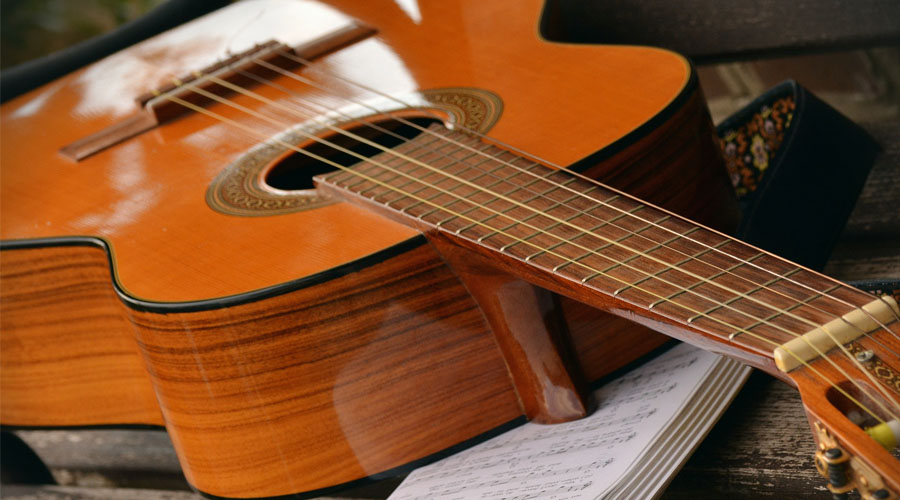
With the functions and features of the modern electric guitar, one cant help thinking about the beginnings of the instrument. Where did the guitar come from? This article tries to give a brief history of the wonderful musical instrument, which is the guitar.
The creation of the guitar cannot be traced to a single person. The guitar came about through the evolution of its predecessors. Its image has also undergone change throughout the centuries.

Today, playing the guitar is a symbol of talent and musical prowess, but during the early times, the guitar was actually a symbol of being poor and it was refuted by most classical musicians.
Predecessors
There have been many guitar-like musical instruments in the ancient times, up to as many as 5,000 years ago. Instruments which look like the guitar were seen in statues which were recovered in archeological expeditions in the Iranian region of Susa.
However, the very first documented mention of the instrument dates back to the fourteenth century. At that time the guitar-ancestor had three pairs of strings (usually referred to as double courses) and a single string with the highest tone.
Some say that the word guitar came from the word qitara. Qitara is an Arabic name for the different kinds of lutes during the early times.
Evolution
The guitar, as we know it, is said to originate in Spain. It is believed that the people of Malaga invented the instrument. The guitar evolved from having three pairs of strings to four pairs of strings and eventually six single strings.
The guitar began to become popular in the 16th century. It was played by the lower and middle classes as a counterpart for the vihuela which was played by the aristocrats. The vihuela was tuned like a lute but had a body similar to that of the guitar.
The guitar made a serious evolution during the 18th century: the double strings where replaced by single strings and a sixth string was added. In the 1800s, Antonio Torres de Jurado gave birth to the classical guitar.
Basically, he increased the size of the body of the guitar. The guitar still struggled because it was considered as an instrument for the taverns – an instrument which could not be used for classical music.
In Spain, where people hated the piano, the guitar found refuge. However, it was also tainted by the views that guitars were for gypsies and for no-good bums who asked for loose change in bars.
Electric guitar
The modern electric guitar was invented in 1931. The electric guitar uses electronic pick-ups to enable it to produce sound. The pick-ups convert the vibrations from the strings into electric signals. The body of the electric guitar is semi-solid or solid, depending on the design.
The structure of the guitar took a great leap when the electric guitar was born, no longer did its sound depend on the structure and construction of the body, but on the quality of the pick-ups and soundboard.
The sounds of the electric guitar can also be altered to be able to achieve a desired tone. The use of the guitar effects box has given the guitar a wide array of sounds. I is continuing to garner popularity in all fields of music, even in classical music.
The guitar is a very dynamic musical instrument. Through evolution, the guitar has made its mark on the modern music scene. From crude instruments with many variations, the guitar has become a real and much-sought after instrument.

